Use teacher-drawn ten-frames to build and read teen numbers.
What it is about
Compose teens as ten and ones using ten frames; distinguish 14 from 41.
Year 1 · 5–6 years · 30 challenges
Before you begin
- Count small sets and compare familiar objects.
What the class will do
- Choose and explain · 30 challenges
Ten and some more
Compose teens as ten and ones using ten frames; distinguish 14 from 41.
Using it in class
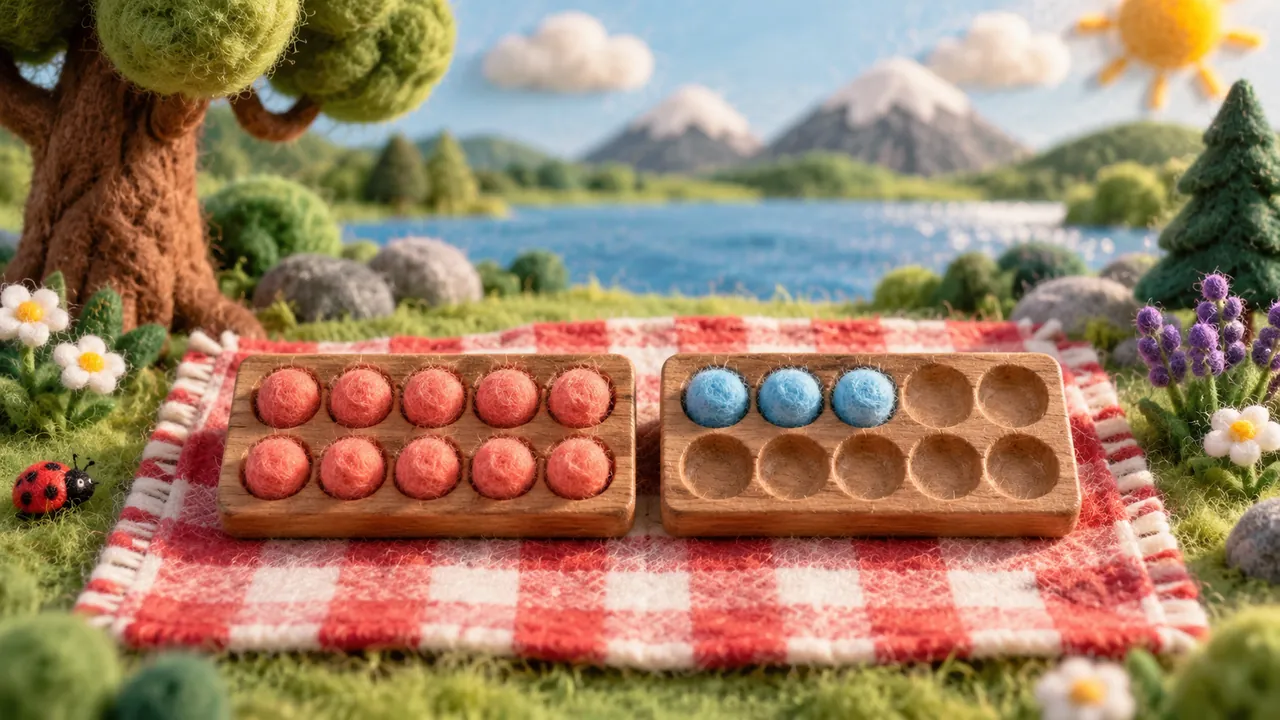
Teacher prepares ten-frames: two rows of five boxes, one counter per box. Draw/show the exact frames and loose ones stated in each prompt; frames are not supplied by the screen. Read prompts aloud. Keep tens grouped, compare teen/reversed numerals, and use counting to check.
Give everyone time to think and discuss before one pupil acts at the board. The class explains and confirms together; hints and explanations stay until you move on.
Use an up-to-date browser on a computer connected to a whiteboard or shared display. Touch, mouse and keyboard; optional audio and reduced motion. No pupil accounts or personal devices.
Choose from 5 challenges up to the full activity. Discussion determines the duration: you set the pace.
A look inside the activities
Choose and explainTeacher: show a full ten-frame (two rows of five boxes) and 1 extra counter. How many counters altogether?
Explanation and discussion
A full ten-frame holds 10 counters. With 1 extra counter, the amount is 11.
Where can we see the ten and the one?
Teacher: show 10 counters in a frame and 3 loose ones. Move 1 counter out of the frame. Which description now matches?
- 10 in the frame and 4 loose
- 9 in the frame and 3 loose
- 9 in the frame and 4 loose
Explanation and discussion
Moving a counter out leaves 9 in the frame and increases the loose group from 3 to 4. Both arrangements still contain thirteen counters.
How could we make a full ten-frame again?
Teacher: show two full ten-frames. One is ten; the other is another ten. How many counters altogether?
Explanation and discussion
Two full ten-frames contain 10 and 10 counters, making 20. This is the next full ten after the teen numbers.
How is this model different from one ten and two ones?

 Neighbours on the line
 Count without missing
 Counting patterns