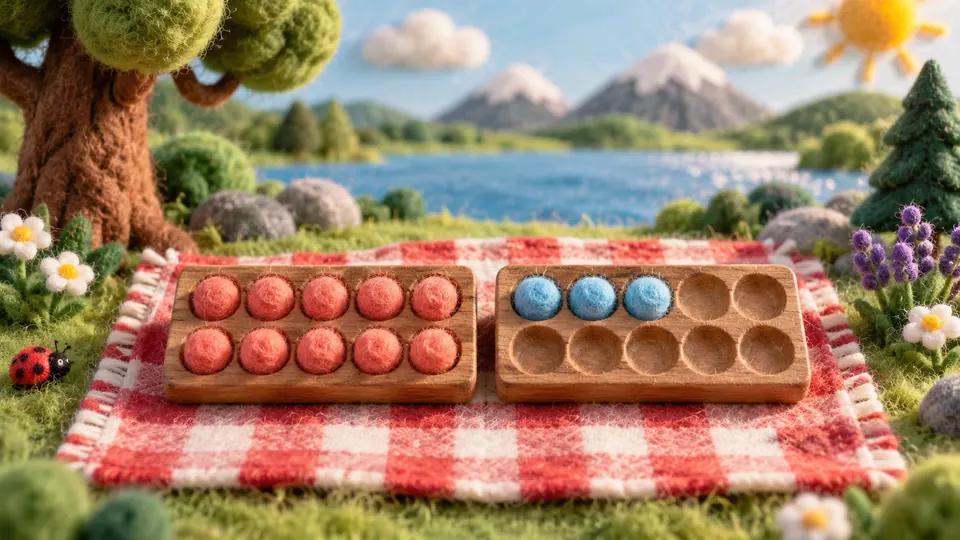
Count every pictured counter once. How many counters are shown altogether?

+
- 4
- 6
- 5
Explanation and discussion
The two pictured groups contain 3 and 2 counters. Counting all of them once ends at 5.
How can we make sure no counter is counted twice?
 KablamMy collection
Count each object once and connect the amount to a numeral or number word.
Count pictured sets to 20, including zero; match numeral, word and quantity.
Year 1 · 5–6 years · 30 challenges
Count pictured sets to 20, including zero; match numeral, word and quantity.
Teacher reads prompts and number words. Use the pictured counter groups where shown; their labels support numeral matching. For requested drawings, draw the exact set before pupils answer. Point to each object once; discuss missed/double counts. No speed requirement or formal addition is needed.
Give everyone time to think and discuss before one pupil acts at the board. The class explains and confirms together; hints and explanations stay until you move on.
Use an up-to-date browser on a computer connected to a whiteboard or shared display. Touch, mouse and keyboard; optional audio and reduced motion. No pupil accounts or personal devices.
Choose from 5 challenges up to the full activity. Discussion determines the duration: you set the pace.
The two pictured groups contain 3 and 2 counters. Counting all of them once ends at 5.
How can we make sure no counter is counted twice?
Nine counters and six counters make 15. Stopping at 9 misses the other group.
How can we keep track while moving from one group to the other?
The picture contains 4 and 2 counters, so the last count, six, tells the whole amount. It does not make every group six.
Could we point to a different counter last and still count six?
 Neighbours on the lineYear 1 · FreeOrder three or four numbers within 100; identify one more and one less.
 Counting patternsYear 1 · FreeCount in twos, fives and tens; identify a missing term without multiplying formally.
 Ten and some moreYear 1 · FreeCompose teens as ten and ones using ten frames; distinguish 14 from 41.