Combine test signatures, choose useful evidence and keep uncertain identifications open.
What it is about
Use multiple observations/tests to identify a material.
Grade 5 · 10–11 years · 30 challenges
Before you begin
Grade4 energy transfer, structures, waves and Earth processes.
What the class will do
Match pairs · 6 challenges
Connect tests and signatures
Match complete supplied test records to distinct properties or reference signatures. Use every relevant result; the candidate sets are local.
Choose and explain · 24 challenges
Identify and check uncertainty
Compare candidate properties, missing results and method controls before choosing a bounded identification.
Using it in class
Everyone cites a test result and proposes a reason before the rotating representative acts. These are supplied illustrative records, not experiment instructions. No tasting or direct smelling of unknowns. Use limitations in discussion. Full bank: 30–45 minutes.
Give everyone time to think and discuss before one pupil acts at the board. The class explains and confirms together; hints and explanations stay until you move on.
Use an up-to-date browser on a computer connected to a whiteboard or shared display. Touch, mouse and keyboard; optional audio and reduced motion. No pupil accounts or personal devices.
Choose from 5 challenges up to the full activity. Discussion determines the duration: you set the pace.
A look inside the activities
Match pairs
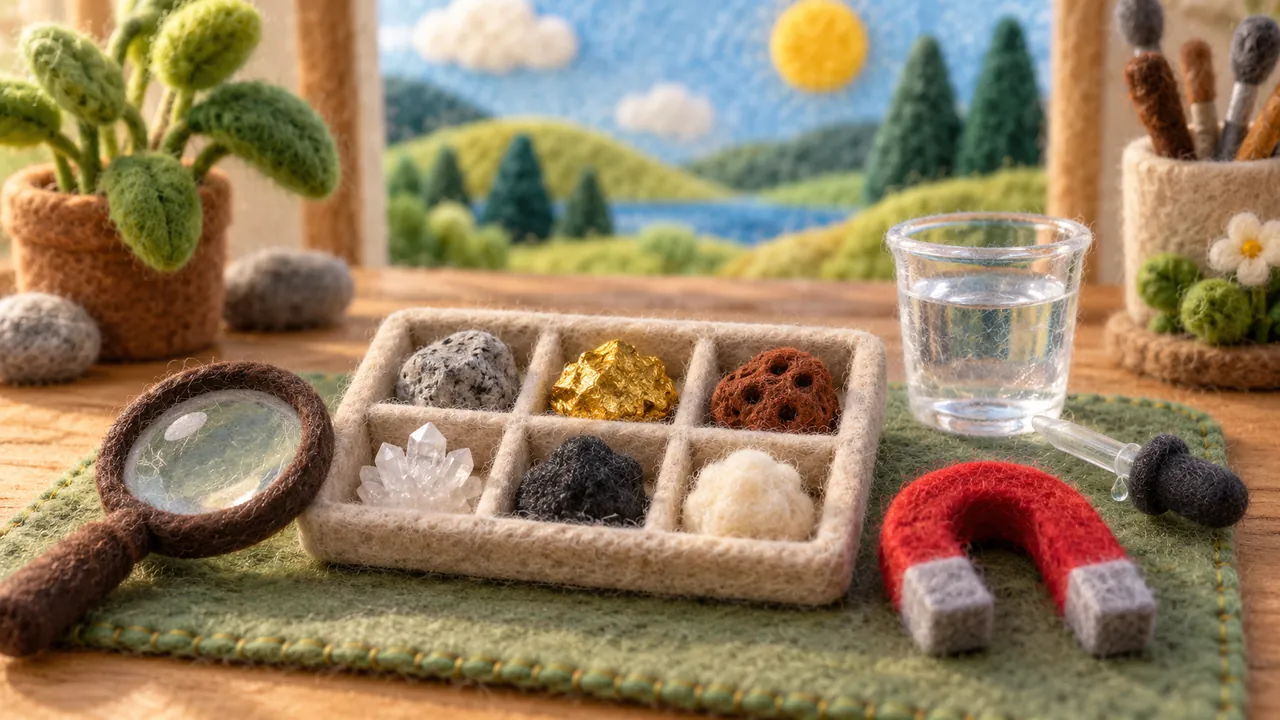
Match each supplied test observation to the property it directly investigates.
The sample is pulled toward a magnet
A known-working test circuit conducts through the sample
A scratch test compares resistance to scratching
A measured sample dissolves in water
Match with:
Hardness
Response to magnetic forces
Solubility in water
Electrical conductivity
Explanation and discussion
Magnetic response, conductivity, hardness and solubility concern different observations. Each local test has a distinct intended property; no one result identifies every possible material.
Why should conductivity and magnetic attraction be recorded separately?
Choose and explain
A and B are white powders. A dissolves in the stated test; B does not. Unknown X is only recorded as white. Can X be identified?
Yes; white alone selects A
No; its dissolving result or another useful property is missing
Yes; every white powder has B’s properties
Explanation and discussion
Both references fit the only known property. Another relevant test is needed; a familiar color is not a unique material identity.
Which supplied test would most directly separate A and B?

 Mixing or a new substance?
 Weight before and after
 Plan a safe comparison